Four months before the deal closed, the data was already moving
#AI #data #transparency #POPIA #OnyxAudit
On 14 August 2026, SpaceX closed its acquisition of Cursor. The figure attached to it is $60 billion, all in stock, and that is the number that travelled.
The number is accurate. It is also the least interesting thing in the filings.
What actually completed
Per the regulatory filing, SpaceX merged its wholly owned subsidiary X67 Inc. with Anysphere, Inc., the legal entity behind Cursor, which now operates as a wholly owned subsidiary. Cursor's common and preferred shares converted into 389,289,254 shares of SpaceX Class A common stock, with further shares issued against vested restricted stock units and other equity awards.
Two details in that sentence are worth holding onto. The consideration was issued under an exemption from public registration, so this was not a market transaction. And the share count is not an estimate; it is a specific number in a specific filing, which means the dilution is measurable rather than reported.
The part that was signed in April
SpaceX's own quarterly filing for the period ending 30 June records that when it took its call option over Cursor in April, it entered a compute agreement at the same time. Under that agreement SpaceX would provide Cursor with GPU cluster capacity, and the two parties would collaborate to improve existing models, Grok among them, and jointly develop new ones.
So the option and the data arrangement were concurrent. One company had the compute; the other had something the first company wanted.
Cursor has since said that Grok 4.5, released in July, was jointly trained with SpaceXAI on trillions of tokens of Cursor data showing how developers interact with codebases and software tools.
Read those two together and the timeline resolves. Between April and August, while the acquisition was still an option and then a pending merger subject to regulatory approval, developer interaction data from Cursor was being used to train a model owned by the acquiring party. By the time the deal closed on 14 August, the exchange it enabled had already happened, and a model trained on it had already shipped.
Where a reader would have found this
Not in a product announcement. The compute agreement appears as a paragraph in a quarterly report, filed with the SEC, in the same note that describes the call option. The filing states that the net amount attributable to the collaboration for the three months to 30 June was not material, which is an accounting statement about money and says nothing about volume of data.
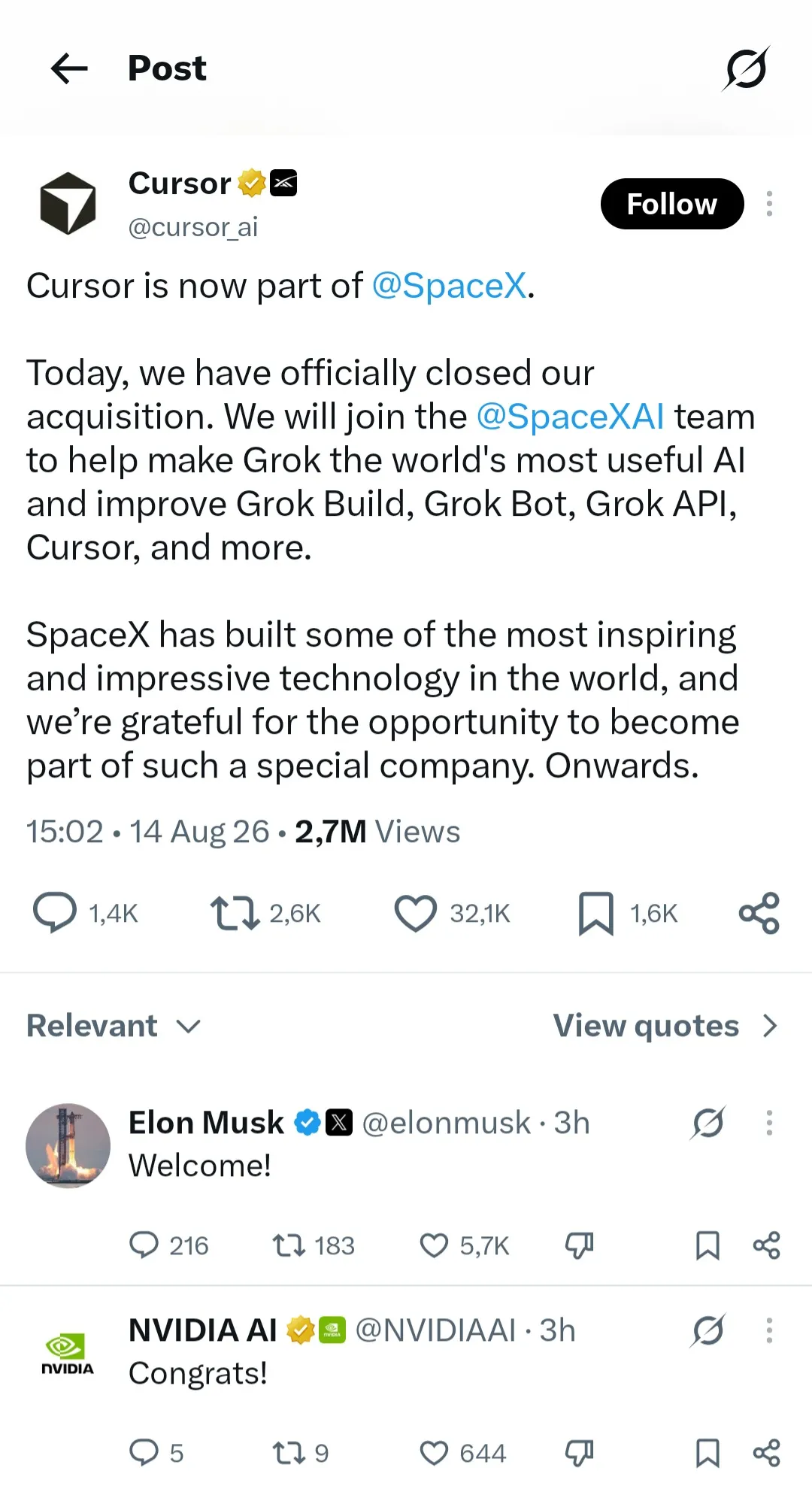
Cursor's own post on the day of closing runs to two paragraphs. It contains no figure, no leadership change, and one substantive sentence, about access to a large fleet of GPUs. The company that told the market it had trained a frontier model on trillions of tokens of its users' behaviour did not mention that on the day the buyer took ownership of it.
That is not a violation of anything. Material terms belong in filings, and the filing carried them. But there is a gap between where the information sits and where a Cursor user would look, and it is the same gap that keeps appearing in this work: the disclosure exists, correctly, in the place almost nobody reads.
What is not established
Cursor states that more than 50,000 enterprises use its tools and that these include 64% of the Fortune 500. Those are the company's own figures and I have not verified them independently.
Nothing in the filings I have read specifies what "trillions of tokens of Cursor data" contains. It could be public repository code, telemetry about editor actions, prompts, accepted and rejected completions, proprietary source, or a subset of these. Whether enterprise customers on paid tiers were inside or outside that set is not stated in anything I have located. Whether users could opt out, and whether any of them knew to try, is likewise unaddressed.
I am not asserting that private code was used to train Grok. I am recording that the composition of the training set is undisclosed and that the arrangement producing it predates the transaction by four months.

The South African angle, briefly
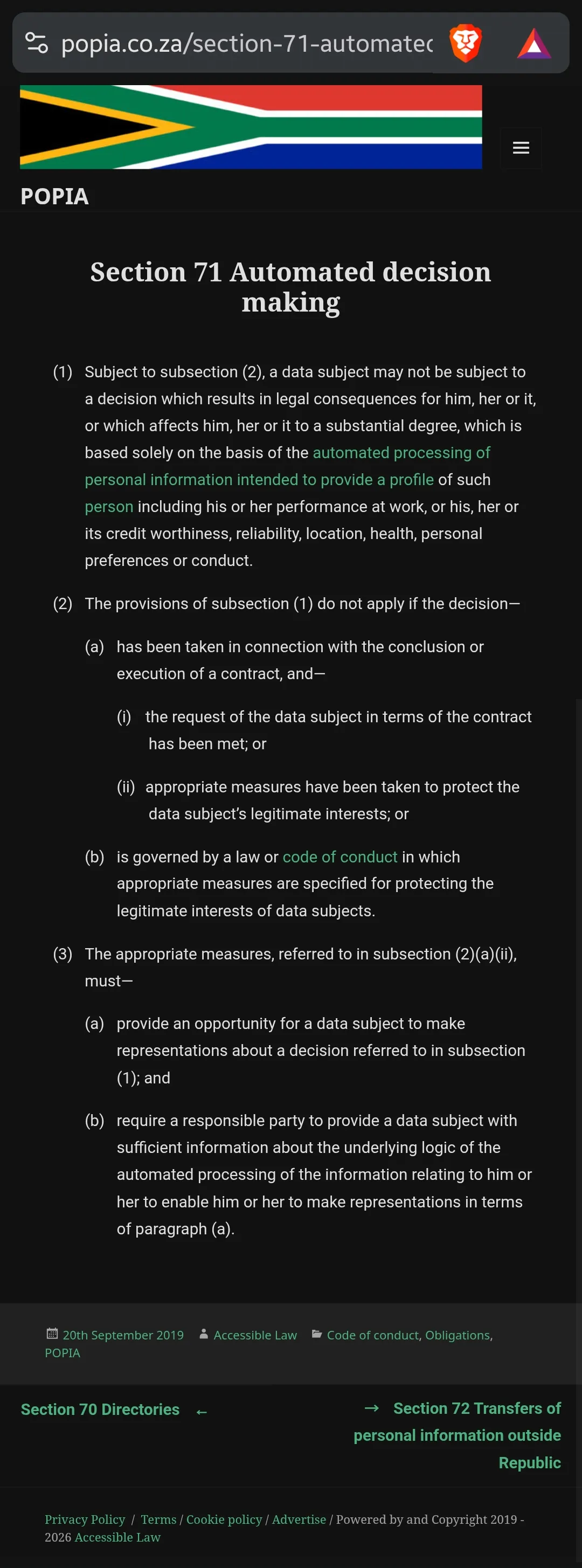
A developer in Durban using Cursor is, on the company's own account, generating data that has been used in a joint training arrangement with a US company. POPIA governs the processing of personal information and places conditions on transborder flows, but whether editor telemetry and code interactions constitute personal information under the Act is genuinely unsettled, and I will not pretend otherwise.
What I can say is that no South African instrument gives that developer a route to ask what was in the training set. The EU's position under the GDPR and the AI Act is contested but at least contested somewhere. Here the question has nowhere to go.
Questions put
To SpaceX and Cursor: what categories of data comprised the trillions of tokens used in the joint training of Grok 4.5; did that set include code or telemetry from paid enterprise tiers; was any opt-out available between April and August 2026, and how was it communicated; and does the closing of the merger change the basis on which Cursor user data is processed.
To the South African Information Regulator: does developer telemetry and code interaction data processed by a foreign AI vendor fall within POPIA, and does section 72 apply to its transfer for model training.
Answers, or documented non-answers, will be published.
Method and limits
The merger terms, the share count and the exempt issuance are Tier A from the SpaceX regulatory filing of 14 August 2026.
The April compute agreement and the description of the collaboration are Tier A from SpaceX's Form 10-Q for the period ended 30 June 2026.
The statement that Grok 4.5 was jointly trained on trillions of tokens of Cursor data is Tier A as a statement Cursor made, and Tier C as to what that data actually contained, which is why this piece makes no claim about it.
Enterprise adoption figures are Cursor's own and are Tier B.
I have not obtained the merger agreement itself, the compute agreement, or Cursor's terms of service as they stood in April 2026. All three would sharpen this and all three are outstanding.
Sources
- SpaceX Corp, regulatory filing announcing completion of the Cursor merger, 14 August 2026
- SpaceX Corp, Form 10-Q for the quarter ended 30 June 2026
- Cursor, company statement on closing, 14 August 2026
- POPIA, sections 71 and 72
Clayton Bax
Published under ONYX Digital Intelligence Following the #OnyxAudit methodology.
- X: @onyxaudit
- Email: onyxdigitalintelligence85@protonmail.com
- https://github.com/Baximus855
- @Onyx_Digital@mastodon.social
"Adjacent to true is not true."
Truth has no flag nor favour, only a standard. And it's heavy